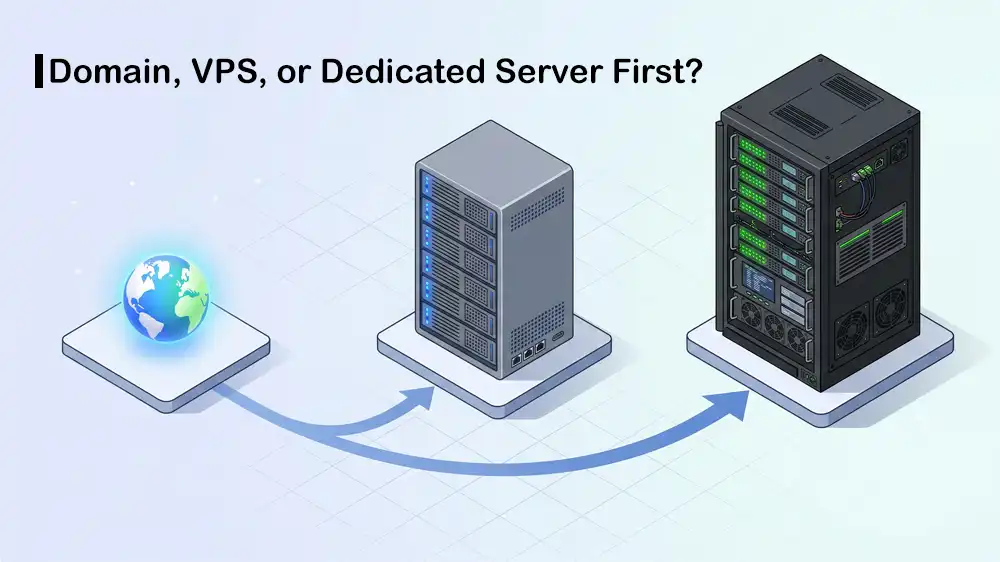
Domain, VPS, or Dedicated Server First? A Practical Launch Order for New SaaS Products
When you are about to launch a SaaS product, one of the first questions you face is whether you should buy a domain, VPS, or dedicated server first. The answer depends on your current stage. Getting the order wrong can waste money or slow you down.
This guide gives you a clear launch order based on where your product actually is, including MVP, early traction, or serious scale.
Table of Contents
Launch Order Matters More Than You Think
Many first-time founders jump straight into buying servers before they even have a product name or a landing page. Others register a domain but leave it parked for months while they figure out hosting.
The truth is simple: each stage of a SaaS product needs a different infrastructure. Spending too much too early eats into your runway, and spending too little at the wrong time causes downtime and lost users.
Let’s break it down into three clear paths:
- MVP Stage
- Scale the VPS
- Move to a Dedicated Server
1. MVP Stage: Domain First
At the MVP stage, your goal is to test your idea with real users as fast as possible; you do not need a powerful server yet. Here is the right order:
1.1: Register Your Domain
Your domain should be the very first thing you buy, which gives your product an identity. It lets you set up a landing page, collect emails, and start building trust before you write a single line of backend code.
Tips for choosing a domain at this stage:
- Pick a short, easy-to-spell name with a .com extension if possible.
- Enable domain locking and WHOIS privacy to protect your brand.
- Turn on auto-renewal so you don’t lose it by accident.
- Register for at least two years to show search engines you are serious.
A domain costs very little compared to hosting, and losing it later to someone else can be a real problem.
Tips: If you already have a domain registered somewhere else, you can follow this domain transfer checklist to move it to your new hosting provider without downtime.
1.2: Get a Basic VPS
Once your MVP code is ready to go live, a small and affordable Linux VPS is the best starting point. You do not need a dedicated server at this stage.
A VPS with 2 vCPUs, 2 to 4 GB RAM, and 40 to 80 GB SSD storage is enough for most early SaaS products. This setup handles a Node.js or Python backend, a PostgreSQL database, and Nginx as a reverse proxy, all on one server.
Why a VPS and not a dedicated server?
- Low cost: VPS plans start from $7 to $30 per month. A dedicated server starts from $80 to $150 per month or more.
- Fast setup: A VPS is ready in minutes. A dedicated server can take hours or days to provision.
- Easy to scale: You can add more CPU and RAM with a quick reboot as traffic grows.
At the MVP stage, every dollar matters. A VPS gives you full root access, SSH, and enough power to serve your first few hundred users without any problem.
1.3: Skip the Dedicated Server in MVP Stage
There is no reason to rent a dedicated server during the MVP phase; you would be paying for resources you do not use. Keep it simple and save your budget for product development.
2. Early Growth: Time to Scale the VPS
Once you have launched, users are signing up, your product is getting real feedback, and traffic is growing. Here is what you must do next:
2.1: Upgrade Your VPS
As your user base grows, your first VPS will start hitting its limits. You must watch for these signs:
- Response times go up: If your Time to First Byte (TTFB) keeps rising and caching doesn’t fix it, your server needs more resources.
- RAM stays above 85 to 90%: Occasional spikes are normal. Constant high memory use means you need a bigger plan.
- CPU steal time increases: On a VPS, high CPU steal time means other tenants on the same physical server are affecting your performance.
The fix at this stage is straightforward; you must move to a higher VPS plan with more CPU, RAM, and storage. Most providers let you upgrade in place without data loss.
2.2: Add a Second VPS
When your app and database are both running on one server, and traffic keeps climbing, you can split them. Put your application on one VPS and your database on another, which improves both performance and security.
You can also add a CDN at this stage to serve static files faster and reduce load on your VPS.
2.3: Strengthen Your Domain Setup
At this point, it’s time to:
- Set up proper DNS records, including A, CNAME, MX, SPF, and DKIM.
- Get a professional email address on your domain.
- Register common variations of your domain name to protect your brand.
3. Heavy Traffic: Move to a Dedicated Server
Once your SaaS product has thousands of active users, revenue is consistent. Uptime and performance are directly tied to your income; this is when a dedicated server makes sense.
3.1: Key Signals to Move to Dedicated Hardware
According to hosting experts, a common rule of thumb is to consider a dedicated server when your VPS resource usage consistently exceeds 70%. Other signs include:
- You have reached the VPS plan limits, and your app still needs more power.
- You need full physical isolation for security or compliance reasons.
- Traffic spikes cause 503 errors or downtime that a VPS upgrade cannot fix.
- You need custom hardware configurations like high-memory setups or NVMe RAID arrays.
3.2: What a Dedicated Server Gives You
A high-performance bare-metal server provides the entire physical machine, all CPU cores, all RAM, all disk I/O, exclusively for your product. There is no noisy neighbor effect, no shared resources, and no virtualization overhead.
This is important for:
- SaaS products with real-time features such as chat, collaboration tools, and live dashboards.
- Large databases that need high and consistent disk I/O.
- Compliance-heavy industries where sharing hardware is not acceptable.
3.3: Recommended Architecture at Scale
A growing SaaS product needs more than one server. Splitting your workload across different machines keeps performance high and makes it easier to find and fix problems.
At this stage, your infrastructure usually looks like this:
| Component | Server Type | Purpose |
|---|---|---|
| Application servers | 1 to 2 VPS or dedicated | Run your backend code |
| Database server | Dedicated server | Handle heavy read/write queries |
| Cache layer | VPS | Redis or Memcached for speed |
| Load balancer | VPS | Distribute traffic across app servers |
| CDN | External service | Serve static assets globally |
Many teams use a hybrid method, including dedicated servers for databases and heavy workloads, and VPS instances for application nodes and workers that need to scale fast.
Quick Summary: Domain, VPS, or Dedicated Server First?
Still not sure where to start? Here is a quick look at what to buy first based on your current stage:
| Stage | First | Second | Third |
|---|---|---|---|
| MVP | Domain | Basic VPS | — |
| Early Traction | Upgrade VPS | Add a second VPS | Strengthen DNS |
| Serious Scale | Dedicated server | Hybrid VPS + dedicated | Multi-server architecture |
The answer to whether you should buy a domain, VPS, or dedicated server first is almost always domain first, VPS second, dedicated server later. Start simple, scale with demand, and only upgrade when real metrics tell you it is time.
Final Words
So, should you buy a domain, VPS, or dedicated server first? The answer is simple: always start with a domain, launch on a VPS, and move to a dedicated server when your growth demands it. Spend smart and let real traffic decide your next upgrade.
Whether you are at the MVP stage or ready to scale, PerLod offers reliable domain registration, fast Linux VPS hosting, and powerful dedicated servers, everything you need to grow your SaaS product.
If you are ready, you can launch your Saas with Domain and Hosting from PerLod.
We hope you enjoy this guide. Subscribe to our X and Facebook channels to get the latest updates.
FAQs
Should I buy a domain before getting hosting?
Yes. A domain is cheap and protects your brand name early. You can register it without buying any hosting and connect it to a server later.
Can I use the same domain with different hosting providers?
Yes. Your domain and hosting are separate services. You can point your domain to any VPS or dedicated server by updating your DNS records.
Do I need a dedicated server to start a SaaS business?
No. Most SaaS products start on a VPS and only move to a dedicated server after reaching thousands of active users with heavy workloads.

