If you've ever bought a domain name, you've probably heard the words registrar vs registry vs reseller, but most people have no idea what these three actually mean or how they're different. Understanding this directly affects who you're dealing with, how easy it is to get support, and what happens when something goes wrong.
This guide from PerLod Hosting breaks down the difference between registrar vs registry vs reseller so you know exactly who's behind your domain name.
Quick Overview of Domain Ecosystem
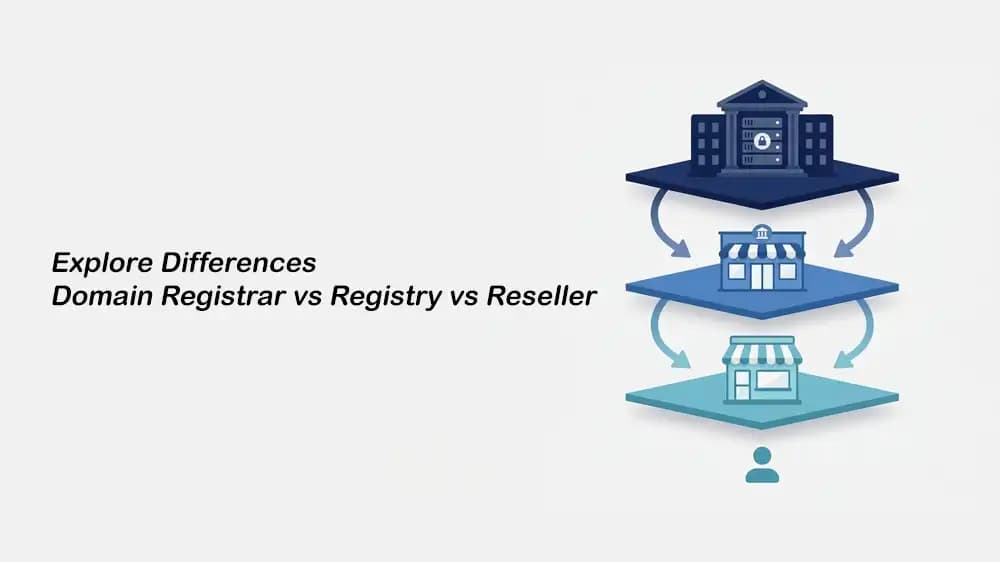
You can think of the domain world like a supply chain:
- At the top, you have the registry: The wholesaler who owns a block of products.
- In the middle, the registrar: The licensed retailer who sells those products.
- At the bottom, a reseller: A shop that buys from the retailer and sells to you.
Behind every domain name you buy, these three Registrar vs Registry vs Reseller roles are always working together.
What Is a Domain Registry?
A domain registry is the organization that manages and maintains the authoritative database for a specific top-level domain (TLD) like .com, .org, or .net.
The registry is like the government that owns all the land in a city, which sets the rules for using it, and keeps the master record of who owns what, and you, as a customer, never deal with the registry directly.
Famous examples of domain registries include:
- Verisign: Manages .com and .net
- Public Interest Registry (PIR): Manages .org
- ICANN: The global body that controls all registries
The registry has absolute authority over its TLD; if something goes wrong at this level, every domain under that extension is affected.
What Is a Domain Registrar?
A domain registrar is an ICANN-accredited company that has the authority to sell domain registrations to customers, acting as the official bridge between you and the registry.
The registrar is the one you actually sign up with. They talk to the registry on your behalf, pay the registry fees, and maintain your domain record. You see their name in your WHOIS data; not the registry's, not the reseller's.
Registrars must meet strict technical and financial requirements set by ICANN to get and keep their accreditation.
What Is a Domain Reseller?
A domain reseller is a company that sells domains without being directly accredited by ICANN; they use a registrar's infrastructure and API to offer domain services under their own branding.
Resellers are often web hosting companies or website builders who add domain registration as an extra service. From the outside, they look just like a registrar with the same dashboard, the same checkout, and the same pricing page.
The key difference is that the registrar's name still appears in your official domain record, not the reseller's. If the reseller goes out of business or stops operating, you may need to migrate your account to a new provider.
Differences Between Registrar vs Registry vs Reseller
These three roles look similar, but each one does something completely different. Here's a quick look at Registrar vs Registry vs Reseller:
| Feature |
Registry |
Registrar |
Reseller |
| Who they are |
TLD operator |
ICANN-accredited seller |
Branded middleman |
| Manages domain database? |
✅ Yes |
❌ No |
❌ No |
| ICANN accredited? |
✅ Yes |
✅ Yes |
❌ No |
| Sells to the public? |
❌ No |
✅ Yes |
✅ Yes |
| Customer support? |
❌ No |
✅ Direct |
⚠️ Limited |
| Appears in WHOIS? |
✅ Yes |
✅ Yes |
❌ No |
| Example |
Verisign |
Namecheap, GoDaddy |
Hosting companies |
What Actually Happens When You Buy a Domain
When you register a domain, it doesn't happen in one step. There's a clear chain of players involved, and your order passes through each one of them. Here's the exact flow when you buy a domain name:
1ICANN2 ↓3Registry (owns .com, .org, etc.)4 ↓5Registrar (ICANN-accredited seller)6 ↓7Reseller (optional middleman)8 ↓9YOU (the customer / registrant)
When you register a domain through a reseller, multiple layers exist between you and actual control of your domain. You interact with the reseller's dashboard, the reseller sends your order to the registrar's API, the registrar contacts the registry, and your domain is registered.
This is why understanding registrar vs registry vs reseller is so important.
Who Is Really Selling You the Domain
When you buy a domain from a standard hosting company or website builder, you're likely buying from a reseller, even if the site never says that out loud.
Here's what that means:
- Your domain record shows the registrar's name, not the reseller's.
- Support requests may take longer because the reseller has to contact the registrar on your behalf.
- If the reseller shuts down, your domains don't automatically disappear, but recovery can be messy.
- Resellers sometimes charge higher prices than registrars.
To verify whether a company is a real registrar, ICANN publishes a full list of accredited registrars on the ICANN official page.
Once you know where to buy your domain, the next step is picking the right one. Check out this guide on how to choose a brandable domain name that still ranks.
Conclusion
The domain world has three key players:
- The registry that runs the TLD database.
- The registrar that sells you the domain with full ICANN accountability.
- The reseller acts as a convenient but indirect middleman.
As a customer, you almost always interact with a registrar or reseller, never the registry. The closer you buy to the registrar level, the more control and support you'll have over your domain.
We hope you enjoy this guide on key differences between Registrar vs Registry vs Reseller. If you are ready to register or transfer your domain with full transparency and direct support, you can buy or transfer your domain through PerLod.
If you already have your domain, you can learn how to point your domain to a VPS and get your site live in minutes.